
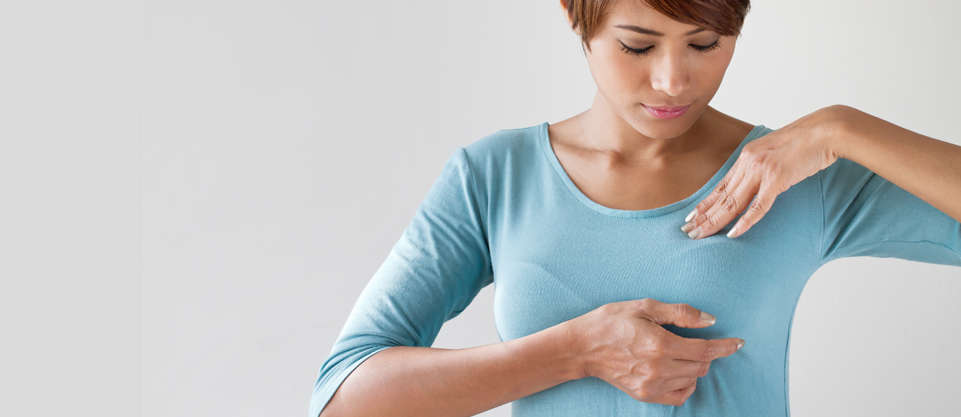
What is breast reconstruction after mastectomy?
Breast reconstruction in Valencia, performed by Dr. Antolín, is an increasingly common surgical procedure for women who have undergone a mastectomy in one or both breasts as a surgical treatment for breast cancer.
The procedure can create a breast that resembles a natural breast in appearance and shape.
 Contact us now
Breast reconstruction is a physically and emotionally rewarding procedure for a woman who has lost one or both breasts.
Following complete or partial removal of the breast due to cancer, the consequence is the absence of the breast or a remaining breast of inadequate shape and volume. This is addressed using different reconstructive techniques involving:
- The use of tissue expanders.
- Implant placement.
- Use of the patient’s own tissues (flaps), such as abdomen—DIEP flap technique, TRAM, back—Latissimus Dorsi—and so on.
Our experience in breast reconstruction is comprehensive, with knowledge and mastery of all possible techniques.
This is why we can offer the patient the best option for her case.
The choice of one technique or another will depend on:
- The appearance of the healthy breast.
- Whether or not you have received radiotherapy.
- The availability of tissues from the different donor areas.
- The patient’s preferences and motivations regarding implant placement or otherwise.
A considerable amount of information must be conveyed by the patient and correctly interpreted by the surgeon in order to establish the most optimal surgical plan, restore the appearance of the lost breast as realistically as possible, and make the most appropriate decisions. The patient must be thoroughly assessed by the surgeon and listened to with genuine interest and care. It is essential that the patient receives excellent care, is well informed, is operated on with skill, and of course, most importantly, that the patient feels genuinely delighted.

Candidates for breast reconstruction surgery
Breast reconstruction is a highly individualised procedure and may not be suitable for everyone.
The candidate should consult with Dr. Antolín as many times as necessary to clarify all her doubts, fears and concerns before making a decision. Dr. Antolín will evaluate her condition and general health, and will plan the treatment that best suits the patient.
Before deciding on surgery, there are some important aspects to consider:
- It usually requires more than one operation.
- Breast reconstruction with implants may not be a good option if you need to undergo radiotherapy, as radiotherapy can cause the skin around the implant to contract.
However, it can be a good option if:
- The patient is able to cope well with her diagnosis and treatment.
- The patient has no additional medical conditions or other illnesses that could impair healing.
- The patient has a positive outlook and realistic goals to restore her breast and body image.
The initial consultation
At the initial consultation, Dr. Antolín will ask the patient to provide a complete medical history, including any health problems she has experienced, any medications she is taking or has taken, and any allergies she may have.
Since this is breast reconstruction following a mastectomy, it will be necessary to understand the patient’s oncological history, family history, breast tumour type, oncological surgery, neoadjuvant treatments received such as chemotherapy, radiotherapy and hormone therapy.
The physical examination is fundamental, assessing the quality of skin after mastectomy, characteristics of the contralateral breast, thoracic anatomy, body constitution, status of potential tissue donor areas, and so on.
Dr. Antolín will order preoperative investigations such as blood tests, chest X-ray or electrocardiogram (ECG).
It may be necessary to request a report from the oncologist, surgeon or specialised imaging investigation.
Patient feedback


Types of surgery and surgical techniques
With tissue expander and implants
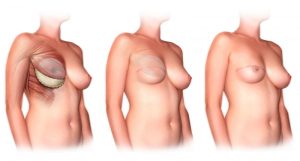
This is an ideal technique in patients who have not received radiotherapy and who have a small, non-ptotic (non-sagging) healthy breast.
By placing a tissue expander, partially positioned beneath the muscle and progressively filled over several weeks with physiological saline, we expand and increase the surface of the remaining skin and subcutaneous tissue after mastectomy.
Once the desired skin surface is achieved, we can create the pocket to house the definitive implant.
We prefer to place anatomical implants or prostheses and in many cases we perform conventional breast augmentation surgery on the healthy breast for symmetry reasons.
With Latissimus Dorsi flap

Autologous reconstruction is the only option when a breast must be reconstructed on a bed that has received radiotherapy, as the limited capacity of the skin to expand discourages the use of expanders or implants.
It is also advisable when we wish to achieve a ptotic breast appearance. Thus, we mobilise skin from the back together with the Latissimus Dorsi muscle to transport it to the thoracic region, allowing us to provide muscle tissue to completely cover an implant, and skin that enables us to achieve the desired breast shape.
Typically this surgery requires the addition of a normally anatomical implant and/or fat grafting with the patient’s own fat.
With DIEP or free TRAM flap
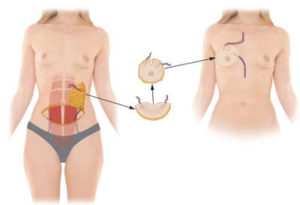
This is the gold standard in breast reconstruction, as it is a technique that allows us to remove a large amount of skin and fatty tissue from the abdomen and transplant it to the thoracic region through microsurgical techniques of arterial and venous anastomosis—that is, we transplant the excess abdominal tissue with its artery and vein, which we connect to arteries and veins of the thorax.
Its main advantage is the low morbidity (minimal damage associated with the procedure), as it uses excess fatty tissue (“a Michelin”) that allows greater possibilities for aesthetic remodelling, and leaves at the donor area the result of an aesthetic abdominoplasty.
It is our first choice when it is necessary to reconstruct using autologous tissue, either because of prior radiotherapy treatment or because the patient wishes to avoid implant placement.
It is also the technique that best mimics large and ptotic contralateral breasts.
Implant selection and padding
Dr. Antolín offers a selection of implant shapes and sizes to provide options meeting patient needs.
There is a choice of standard round implants, which provide a higher, fuller profile, or anatomically shaped implants that mimic the natural breast shape.
You can go further still to achieve a natural look and feel by using fat grafting to help cushion the implant, minimise the silhouette and create a smoother cleavage line.
Postoperative care and recovery
- Shortly after surgery, the patient will be encouraged to move her arms, but not for any strenuous activity such as getting out of bed or lifting heavy objects. The nursing staff will assist her in and out of bed.
- The day after surgery, the patient can sit in a chair at the bedside.
- By the second day, most patients walk unaided.
- You will probably receive intravenous fluids for one to two days.
- The patient may have a urinary catheter during the night or until she is able to walk to the toilet.
- You will also have drains at the incision sites. If you go home with these drains, you will receive instructions on how to care for them.
The length of your hospital stay depends on the type of breast operation and your recovery progress:
- If the patient had implants, the average hospital stay is 1 to 2 days.
- Flap procedures may require a 5 to 6 day stay.
Recovery care following surgery
- It is advisable to set up a “recovery area” at home. This may include pillows, ice packs, a thermometer and an easily accessible telephone.
- The patient should arrange for a relative or friend to drive her to and from the hospital or clinic. Someone should also be with the patient for at least 24 hours after she returns home.
- After returning home, the patient can expect some pain, swelling and bruising for 2 to 3 weeks.
- You may be asked to apply medication to the suture area or change dressings at home.
- Dr. Antolín will advise the patient on how to shower, bathe and care for her wounds.
- Most women return to normal activities within 6 to 8 weeks after surgery.
- It may take several additional weeks before you are able to exercise vigorously.
- Mastectomy and breast reconstruction will result in areas of numbness where the surgery was performed. Instead of feeling pain where tissue was removed, the patient may experience numbness and tightness. Eventually, some sensation may return to the breasts.
- Most scars will fade over time.
- The shape of the reconstructed breast will gradually improve over the months.
- The patient will be asked to return to the clinic for regular follow-up appointments.
- If you have a temporary expander implanted, it will be expanded with saline once weekly until the desired size is reached (usually six to ten clinic visits).
- The patient should continue to perform monthly breast self-examinations and have an annual mammogram.
- Breast reconstruction does not change the risk of cancer recurrence and usually does not interfere with treatment.
- The final results of breast reconstruction surgery can be seen after 6 months.
Schedule an initial consultation to meet with Dr. Antolín and learn more about plastic surgery procedures in Valencia and Alcoy.
Would you like a QUOTE?
Frequently asked questions
What will reconstruction surgery do?
Breast reconstruction is a surgical procedure that reconstructs one or both breasts to resemble natural breasts in appearance and shape.
It is usually performed immediately after, or some time following a mastectomy.
What are the most commonly used techniques?
There are two main types of breast reconstruction: with implants and with flap.
- When using implants, an implant is placed beneath the skin and muscle to recreate the breast shape.
- If a flap is used, skin, fat and muscle are taken from another area of the body to create the new breast.
The most appropriate procedure for each patient will depend on her age, overall health status, size and shape of the contralateral breast and available body tissue; and most importantly, whether or not there is a history of radiotherapy.
What type of anaesthesia will I require?
Breast reconstruction is always performed under general anaesthesia.
The surgeon and/or anaesthetist will ask about all medications the patient is taking or has taken, and any allergies she may have. The patient should have an updated list of these medications prior to surgery.
What are the potential risks and complications?
Breast reconstruction surgery is generally safe, but like any surgical procedure, it is not without risks and complications. Some general complications and risks associated with surgery may include:
- Excessive bleeding at the operation site.
- Fluid accumulation around the operation site.
- Infection that may require antibiotic treatment or additional surgery in some cases.
- Allergic reaction to sutures, dressings or antiseptic solutions.
- Formation of a large blood clot or haematoma.
- Pain, bruising and swelling around the operated site(s).
- Slow healing, often related to smoking or diabetes.
- Short-term nausea following general anaesthesia and other anaesthesia-related risks.
Some possible complications and risks associated with implant reconstruction surgery may include:
- Infection around the implant.
- Capsular contracture, in which firm scar tissue forms around the implant, causing loss of shape and softness.
- Implant rupture or deflation.
- Leakage of implant contents (silicone gel or saline solution).
- Asymmetry (unevenness) of the breasts.
- Calcium deposits in the scar capsule around the implant.
- Granulomas or lumps in local lymph node tissue formed by silicone leakage.
- Migration of the implants from their original position.
Some possible complications and risks associated with flap breast reconstruction surgery may include:
- Loss of blood circulation in the reconstructed breast due to clotting in the reconnected blood vessels. This can lead to flap tissue death (necrosis).
- Small areas of hardness (fat necrosis) may develop in the new breast.
- Fluid collection (seroma) at the flap site.
- Weakening of the abdominal muscle, which may cause a hernia.
- Difference in size and shape (asymmetry) between natural and reconstructed breasts.
- Temporary reduction in full arm movement on the side of the reconstructed breast.
Will I have scars?
Scarring is an inevitable part of any invasive surgery.
Dr. Antolín will strive to minimise scars and keep them as inconspicuous as possible by placing incisions in easily concealed locations. In this way, the scars will follow the natural lines and creases of the skin.
The scars fade over time and become barely noticeable.
Will I need revision surgery?
Breast reconstruction usually requires more than one operation to achieve an optimal result. Revision surgery may also be necessary to correct minor irregularities.
Request an initial assessment for your surgery with Dr. Antolín.