

What is Otoplasty?
Dr. Antolin explains the procedure followed for otoplasty or cosmetic surgery of the ears in his clinics in Valencia and Alcoy.
Otoplasty is the surgery that aims to correct ear malformations and their anomalous position in the skull. The objective of this facial operation is to repair the ears that protrude, allowing its repositioning and remodeling.
There are 3 types of classic anomalies, which may occur in isolation or in combination.
- A defect of the cartilage plication (antehelix) that causes the ear to appear too smooth, unfolded.
- Hypertrophy of the central cartilage (the concha) that accentuates the forward projection of the ears.
- An excessive retroauricular angle (between the auricle of the ear and the skull) that can participate in the mechanism of detachment, separation of the ear.
Any adult with an anomaly or malformation of the ear can undergo ear surgery or ear operation for ear correction.
In children, on the other hand, it is advisable to wait until 7 years of age, once the growth of the ear is almost complete, and as long as there is motivation on the part of the child to correct this problem.
Recently, another solution has appeared that allows in some cases to correct the problem of protruding or separated ears, without going through the operating room. This is the Earfold implant.
There is a lot of information that the patient must transmit and the surgeon must know how to interpret it in order to establish the most optimal surgical plan and make the most appropriate decisions. The patient must be rigorously evaluated by the surgeon and listened to with interest and attention, especially in cases of children who are self-conscious about their ears. It is essential that the patient is well cared for, well informed, well operated, and of course, and not least, that he/she is very, very excited.

Suitable Candidates for Ear Pinning Surgery in Valencia & Alicante
Otoplasty is a surgical intervention that corrects a series of anomalies related to the external ear. It is a plastic surgery procedure, which deals with improve the way the ears look and sit on the head.
Here are some tips that can be used to determine if otoplasty surgery is necessary:
- You feel that your ears bother you and are not comfortable on your head, especially when combing your hair or wearing certain accessories.
- You feel that your ears are too big and take attention away from your face.
- Your earlobes are wide and oddly shaped.
- Your ears stick out from your head.
- The ears are unequal or asymmetrical.
- The ears are oddly shaped, due to an accident or genetics.
If the ears protrude perpendicular to the head, a cosmetic surgery operation for correction of protruding ears, called otoplasty, can help bring the ears closer to the head.
With this surgery, the ears can return to a 15 to 20 degree orientation or angle with the head. Studies have found that at these angles, the ears look more natural.
 Contact us now
The 1st Consultation for Ear Pinning Surgery (otoplasty)
Prior to otoplasty surgery, all of our patients will have several scheduled consultations with Dr. Antolin.
In this 1st visit FREEIn this 1st FREE visit, the candidates and their parents (for cases in which the patient is a minor, which is very common in this surgical procedure), should get all the answers to their questions, have the doctor review their goals and make sure that both are in agreement on what the desired results are.
The essential approach is to clearly define the objectives of otoplasty.
The patient or his/her parents must explain perfectly the change to be achieved. It is advisable to have at least two consultations before the operation.
This is also the time for the patient to ask all the questions to resolve all the doubts that may arise regarding the operation of their ears.
The consultation allows the surgeon to carefully examine the ear deformity, establish a preoperative evaluation and diagnosis, assess the patient’s motivations and decide on the type of anesthesia.
Dr. Antolin will provide a detailed and personalized quote specifying the techniques to be used.
Surgery characteristics
- Otoplasty is performed in the operating room, usually under local anesthesia and sedation, although in selected cases such as children, general anesthesia may be advisable.
- The duration of the surgery ranges between 1h and 1h and a half.
- Through an incision in the back of the ear we remove a variable size spindle of skin and access the cartilaginous structure of the ear.
- By means of definitive sutures we bring the ear closer to the skull, leaving it at a more harmonious distance.
- With other sutures we mold the abnormally deployed antehelix cartilage, which gives the characteristic appearance of these ears.
- In certain cases, partial removal of excess cartilage (shell) may be necessary. Once the remodeling and repositioning of the cartilage has been achieved, we close the cutaneous defect created.
- In many cases, the intervention ends with the correction of the earlobe, which may also be abnormally oriented.
- Once the surgery has been performed, patients are hospitalized for a few hours until full recovery.
- The scar in this procedure is not a problem, since it is located discreetly on the back of the ear and becomes imperceptible with time.
Postoperative and recovery
After the operation, patients are admitted to the hospital for a few hours for post-anesthetic recovery, initiation of food tolerance, ambulation and pain control. This way we get the patient to return home with the highest level of comfort and safety possible.
Patients go home with mild pain that is controlled with minor analgesics and a compressive bandage that we remove the next day or two days later.
Once this compressive bandage is removed, patients should wear a bandage to keep the ears positioned and protected for 1 to 2 weeks.
Patients see the results of the operation immediately, but it takes 3-4 weeks for the effects of swelling, redness and bruising to disappear and for the skin to return to its initial thickness.
An oft-repeated comment following otoplasty is the
“I could have had it done before” o
“if I had had surgery as a child like my son…”,
and there are patients who deal very well with protruding ears; people who are operated in a more casual way and patients to whom the issue of their ears has meant complex, insecurity, social withdrawal and even childhood traumas.
Consequently, the latter are astonished to see how, after a simpler and more bearable process than they thought, they manage to resolve a concern, a complex and even a change in their self-esteem and in their way of relating to others (as happens with children).
What is the postoperative phase like?
To avoid problems and complications, it is essential to follow Dr. Antolin’s recommendations to the letter.
- During the first few days, it is common to feel discomfort in the treated area due to the inflammation of this part of the body and the fact that the ears must remain bandaged to be in the proper position. However, this discomfort can be reduced by taking painkillers that will be prescribed by Dr. Antolin.
- After two or three days, Dr. Antolin will remove the bandages and the patient will be able to leave the ears in the open air, although he/she will still have to wear a bandage to sleep for a few more days.
- Complete recovery from the operation occurs after 4 to 6 weeks, but the patient can resume normal life after 7 days following the operation.
- Hygiene is essential to ensure a good recovery. Therefore, the ears should be cleaned every day with warm water and neutral soap. To dry them, it is recommended to use fresh air instead of a towel.
As with any type of surgery, it is important that the patient attends follow-up visits to ensure a good recovery of the ears. Each patient is different and evolves at their own pace.
Therefore, individual and personalized follow-up is necessary to ensure that healing progresses adequately or, if necessary, to take the necessary measures in time to remedy a possible disorder.
Sleeping after otoplasty
During the postoperative phase of otoplasty, the patient must first wear a special sleeping bandage for the first few days and then an elastic bandage for about two weeks.
The purpose of both the bandage and the elastic bandage is to protect the wound and ears and help them heal. Therefore, this practice is essential, even if it can be embarrassing.
Exercise after ear surgery
Although it is not a complex operation, it is recommended that the patient avoid sports for a while.
After four weeks postoperatively, you will be able to resume some sports activities in a less intense manner. It will take at least six weeks to resume contact sports activities.
Children should avoid overly aggressive games and activities that require too much effort for a period of six weeks.
Ear care
Once the patient has fully recovered from the operation, he or she will no longer need to take special care of his or her ears, as the incisions have healed and therefore no longer present any risk.
Although the scars on the back of the ears are practically invisible, it is recommended to apply sunscreen to this area at least 20 minutes before each exposure to the sun, and to repeat the application every two hours for at least one year after the operation.
This practice helps to protect the scars as much as possible and to prevent them from bleaching in the sun.
Otoplasty Results
This simple and reliable intervention generally does not observe recurrence.
In addition to the aesthetic benefit, ear surgery can put an end to possible derogatory comments that could create psychological problems.
Otoplasty surgery definitively corrects ear anomalies by reshaping and repositioning the cartilage, to obtain “glued” ears, symmetrical, well folded, non-hypertrophic, of natural size and in perfect harmony with the whole face.
It takes a few months to evaluate the final result, the time for the tissues to soften, for the edema to resolve and for the cartilage relief to be optimal.
Imperfections in otoplasty results
Although it is very rare, small defects may appear with the passage of time: a slight asymmetry after healing, irregularities in the relief, the appearance of threads under the skin…
In this case, touch-ups can be performed under simple local anesthesia.
Schedule an initial consultation to meet with Dr. Antolin and learn more about plastic surgery procedures in Valencia and Alcoy.
Do you want a QUOTE?
Patient feedback


Frequently Asked Questions
What are the different types of cosmetic ear surgery?
The most common form of otoplasty is used to make the ears less prominent, as it is used to make the ears more prominent. decrease the angle that these form with the head and therefore, bring them closer to the head.
Otoplasty can also be used to make the ears appear smaller or larger, or to reshape part of the ear, for example, to make the earlobes smaller or to remove a protrusion on the outer edge of the ear.
Otoplasty can also be used to correct congenital defects or damage due to trauma, such as a torn earlobe due to an ear piercing. If only one ear is deformed or protruding, the other ear can be surgically altered.
What is the best age to undergo this procedure?
Unlike many forms of cosmetic surgery, ear reshaping surgery is commonly performed in children, in some cases from 7-8 years of age.
Ears usually reach their adult size around this time, and many parents believe that by having the procedure done early, they can prevent bullying or teasing that might occur about prominent ears.
Otoplasty is also commonly performed on adolescents and adults of all ages.
Who is a candidate for otoplasty?
Ideal candidates are those who wish to change the size, shape or proportion of their ears, and are realistic about the expected outcome of the procedure.
Most patients who are in good general health can undergo ear reshaping surgery.
What happens during surgery?
The entire procedure usually takes between one and two hours, during which time one or both ears will be corrected to ensure the most symmetrical and natural result.
Dr. Antolin will make small incisions in front, behind or in the skin folds of the ears, depending on the type of imperfection to be corrected. Through these incisions, the natural skin and cartilage can be trimmed, augmented or reshaped.
If prominent ears are a concern, internal sutures are used to reposition the ears closer to the head.
What can I expect after the procedure?
You may return home after recovering from the anesthesia, although you will need someone to drive you home.
After surgery, some tenderness or discomfort is expected. Side effects such as swelling, bruising and redness are common and usually last about a week.
The layer of surgical dressing over your ears may interfere with your hearing temporarily, although the surgery itself will not affect your hearing.
What can I do after the operation?
During the first week after surgery, wear a button-down shirt and sleep on your back with your head and neck elevated to reduce swelling.
Avoid bending over, which increases pressure in the ear area.
Most patients return to work or school within a week to ten days, although strenuous exercise and contact sports should be avoided for a month.
What will I look like later?
Immediately after otoplasty, your ears will be wrapped in surgical gauze with a soft headband to protect them and keep the gauze in place.
Your ears will be swollen and bruised, but because they are covered, you may not notice this effect immediately.
What are the risks?
While otoplasty is usually very safe, there are some potential complications. These include hematoma, infection, pathologic scarring and asymmetry.
Please note that there is no risk of hearing change, as this procedure does not affect the inner ear.

Earfold (Otoplasty without surgery)
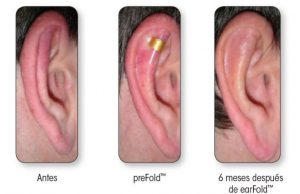
The Earfold is an absolutely new device innovative device that allows to correct the so-called protruding ears:
- No need to undergo surgery.
- Allowing the patient to to return to their normal routine immediately.
- And with excellent excellent results.
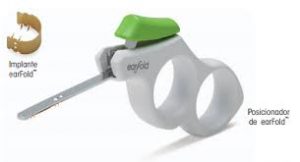
Ear fold is an implant placed under the skin of the anterior face of the ear, which allows us to fold the cartilage (antehelix) properly, correcting the deficit of plication typical of protruding ears.
This device is placed in the office on an outpatient basis, without the need for general anesthesia or sedation. It only requires local anesthesia for placement and a minimal incision of 1.5 cm.
It does not require bandaging; recovery time is minimal and the patient will only perceive a small swelling sensation that will disappear after a few days.
We are one of the few accredited centers in Spain for the treatment of prominent ears by means of this simple non-invasive technique, which is done on an outpatient basis and under local anesthesia and consists of reshaping prominent ears by means of devices that maintain the ears with the proper shape and projection.