
Although spider veins are common and usually harmless, they can also be uncomfortable, irritating and affect self-confidence.
Lifestyle changes and the use of compression stockings are usually the first step in managing enlarged and visible varicose veins.
When these measures are not sufficient, a medical procedure may be required to treat the affected varicose veins and spider veins.
Sclerotherapy and venous laser treatments are modern treatment options used to improve visible spider veins, varicose veins and their associated symptoms.
What is varicose vein sclerotherapy?

Sclerotherapy is one of the most commonly used treatments for varicose veins and spider veins. This procedure involves injecting a sclerosing solution directly into the vein, causing it to gradually collapse and fade over the following three to six weeks.
This solution affects the lining of the blood vessel, known as the endothelium. The controlled irritation it produces causes the vein wall to close. Over time, the treated vein is gradually reabsorbed by the body through a natural process.
In varicose vein and spider vein sclerotherapy, a sclerosing agent is injected into the veins using fine disposable needles. The procedure has been refined over recent years to allow the treatment of small superficial veins, known as microsclerotherapy.
- The procedure is simple and is performed on an outpatient basis at our clinic.
- In most cases, the solution is introduced directly into the vein through a small needle. You may experience mild discomfort for a few minutes, especially when larger veins are treated.
- Sclerotherapy treatment usually takes between 15 and 30 minutes.
- Complications are uncommon, but may include pigmentation, blistering and, rarely, the formation of a small skin ulcer.
- We encourage our patients to maintain an active lifestyle immediately after treatment.
- You can return home after treatment, as no sedation is required. The procedure is generally well tolerated and virtually painless.
Sclerotherapy treatment for varicose veins and spider veins
The sclerosing agents used have an excellent safety profile and may be converted into foam for the treatment of larger varicose veins. These sclerosants are processed by the liver, as are many medicines, and do not accumulate in the body.
Foam sclerotherapy can be more efficient in selected cases, as it may require a lower total dose of sclerosant and can improve contact with the vein wall. The foam can also reduce the number of injections required.
The sclerosing solution damages the inner lining of the vein wall and causes the vein to close, preventing blood from flowing through it. Small veins may fade within approximately 6 weeks, while larger varicose veins usually take longer.
- Several veins can be injected during a single treatment session.
- This may involve 6 to 10 injections for larger varicose veins and 50 or more injections for smaller spider veins.
- Larger and deeper veins should usually be treated first.
Are there any side effects?
- It is normal for the injection site to become red immediately after sclerotherapy treatment.
- The vein may appear slightly swollen or inflamed, and mild bruising may occur. This usually settles within a few hours after the procedure.
- Some spider veins may appear darker at first, but this gradually improves as the treatment takes effect and the body naturally absorbs the treated veins.
- A brownish mark may occasionally appear around the injection site, but this usually fades over time.
 Contact us now
Sclerotherapy aftercare: compression stockings and exercise
Compression stockings
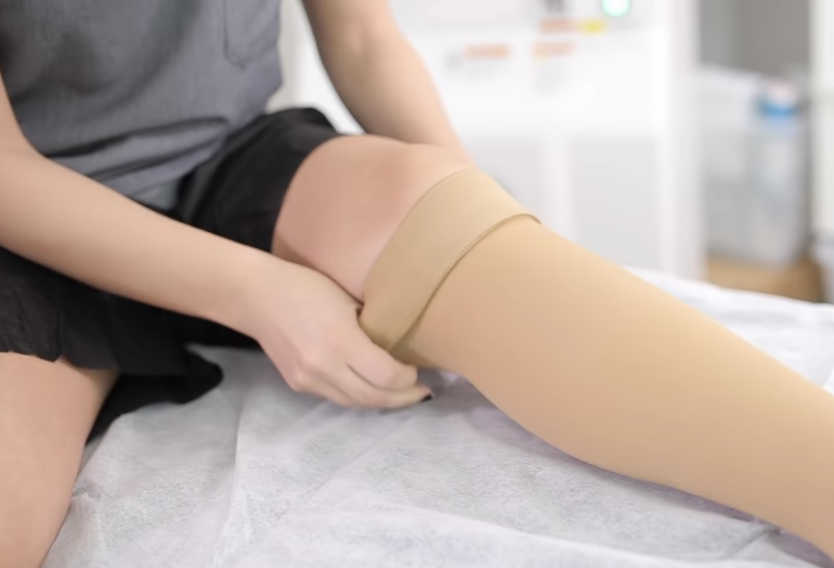
After each sclerotherapy session, you may be advised to wear class II medical compression stockings to help the treated veins close properly.
Compression stockings are usually worn for one to two weeks, depending on the size of the injected veins. It is important to follow the recommended time in order to achieve the best possible results.
The advantages of wearing compression stockings include:
- minimising blood trapping and pigmentation;
- reducing the number of treatments required;
- decreasing the risk of deep vein thrombosis, known as DVT, thrombophlebitis and recurrence of treated spider veins or varicose veins.
Occasionally, compression stockings may not be necessary for very fine veins. Medical compression stockings provide graduated compression, with maximum pressure at the ankle and less pressure towards the thigh. Stockings are generally more effective than bandages, as it can be difficult to maintain adequate compression with bandaging for more than a few hours.
Exercise
It is advisable to walk for at least 30 minutes a day while wearing the stocking, including on the day of treatment. Walking can help relieve occasional discomfort.
Walking also helps keep the risk of deep vein thrombosis to a minimum and is particularly recommended for up to 6 weeks after the treatment of larger varicose veins.
Swimming, cycling or low-impact aerobic exercise may also be suitable alternatives.
Results and number of sessions required for varicose vein sclerotherapy
For superficial veins, treatment results cannot be guaranteed, as response varies from patient to patient.
- After one treatment, most patients can expect an improvement of approximately 50% to 70% in the treated area.
- Two sclerotherapy sessions in the same area are usually required to obtain good results. In some cases, three or more sessions may be necessary to achieve greater clearing.
- The fading process is gradual, and treated veins may continue to fade slowly for up to 6 weeks or more after a session.
- For this reason, sclerotherapy sessions are usually spaced at least 6 weeks apart.
What are spider veins?
In medical terms, spider veins are called telangiectasias and are often associated with larger dilated blood vessels, usually blue or green in colour, known as reticular veins. Dilated blood vessels can cause discomfort or pain, particularly when standing for long periods of time.
Spider veins are small red or blue veins that can appear anywhere on the body, but are most commonly found on the legs, ankles, face, chest or abdomen.
They are extremely common.
Spider veins may look like short, apparently unconnected lines, each about the width of a hair, or they may resemble a spider web or the branches of a tree.
How does laser treatment for spider veins work?
Laser treatment for spider veins is a fast, effective and non-invasive procedure that uses a focused beam of light to heat and damage the affected veins. When laser energy is applied to the treatment area, it targets the blood pigment and heats the vessel without damaging the surrounding skin or tissues.
Over time, usually four to six weeks after treatment, the vein is reabsorbed by the body and gradually disappears.
Blood is redirected to healthier veins.
What causes spider veins?
Spider veins are often associated with varicose veins that feed into nearby smaller blood vessels. When the damaged section of vein, or varicose vein, fills with blood and becomes enlarged, the overflow of blood can create small spider veins close to the surface of the skin.
This is why it is important to treat the underlying cause, rather than only the spider veins visible on the surface.
Are spider veins dangerous?
In general, spider veins are not dangerous. However, if they are caused by underlying venous disease, the condition responsible for them should be properly assessed and treated, as it could lead to further complications if left untreated.
Do I need these veins?
Although dilated blood vessels do carry blood, they are often inefficient and are usually not necessary for healthy circulation.
The body will already have established an alternative route for blood to return more efficiently to the heart. For this reason, these veins can usually be treated without negatively affecting circulation.
In many cases, treatment can improve venous circulation.
Sclerotherapy has an approximate 80% chance of improving appearance, depending on the severity of the problem. The treatment also usually helps relieve symptoms caused by the affected veins.
Spider veins appearing on the lower leg, ankle or foot may be a sign of more severe varicose vein disease. Spider veins in these areas are often fed by a larger internal vein that is not functioning properly and could lead to further complications if left untreated.
Other aesthetic medicine treatments
Anti-wrinkle injections for forehead lines and frown lines – Hyaluronic acid dermal fillers – Chemical peels – Facial mesotherapy – Face and body radiofrequency – Spider vein sclerotherapy – Soprano laser hair removal