

What is a neck lift or cervical lifting?
The neck lift, also called cervical lift or cervicoplasty, is a plastic and cosmetic surgery procedure alternative to facelift, which seeks to rejuvenate and redefine the neck and jaw area, eliminating laxity and sagging, excess fat and tightening the internal muscles. This allows recovering a firmer, more refined and harmonious profile, especially in people who feel that their neck makes them look older or blurs their facial features.
Why is a cervical lift performed?
With the first signs of ageing, it is common for facial skin to lose firmness and sagging to occur, a phenomenon that usually starts to become noticeable around the age of 40, especially in the neck area.
This loss of elasticity in the neck skin can become a source of insecurity for some people.
The neck lift plastic surgery is an effective solution for these cases, as it offers prolonged and positive results.
Through this procedure, facial rejuvenation is achieved in the neck area, giving smoother and firmer skin and eliminating the laxity that may be a cause of concern for the patient.
What are the benefits of a neck lift?
The physical benefits of a neck lift include achieving a more youthful appearance for your face:
- A dramatic improvement in the appearance of the neck and jawline.
- Noticeable reduction of laxity and wrinkles.
- A more defined and youthful neck and jawline contour.
- This aesthetic improvement can lead to significant psychological benefits, such as an increase in self-esteem and self-confidence.
- Patients often experience greater satisfaction with their body image and feel more comfortable and confident in their appearance, which can positively influence their emotional wellbeing and social interactions.
Facelift, neck lift or neck and jowl lift?
Sagging skin on the face and a drooping neck are often the first signs of facial ageing. Both a neck lift and a facelift can correct these problems.
- A facelift improves the appearance of the mid-face, the lower face, and the cheeks, jowls and neck. Facelift or mini facelift can be combined with the double chin operation to remove excess fat.
- The neck lift will improve the appearance of the neck only, and is therefore more suitable for younger people (40s and up) who do not have any sagging or looseness of the skin of the lower face.
- Some young people have full or round necks due to fat accumulation and this can be resolved by neck liposuction.
Young patients who have excessive sagging and drooping of tissues in the neck area compared to the lower third of their face may undergo an isolated neck lift, although this is generally rare.
In most cases, neck and facelifts are performed as a combined treatment.
As the face and neck are linked and depend on each other to define their appearance, Dr. Antolín routinely performs the face and neck lift together to produce more aesthetic results.
By tightening the underlying muscles and lifting the skin in the correct direction, Dr. Antolín performs this combined treatment to restore the shape and symmetry of the face.

Neck liposuction
Neck and jowl liposuction is a surgical procedure that removes fat cells in the neck and jowl area through a small suction device, whilst generating retraction in the treated area.
- Three small incisions in the skin are required to insert the device used to extract the fat.
- Liposuction only removes fat and does not treat excess skin or platysma muscle that may be redundant in the neck.
- It can be a useful adjunct when recontouring the neck with a neck lift procedure.
- Occasionally it is performed in isolation without other procedures.
- Neck liposuction should be done conservatively to avoid an “exaggerated” appearance and to prevent sagging of the skin.
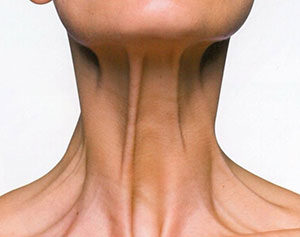
Platysmaplasty
This facial rejuvenation procedure focuses on the platysma muscle, which is located just below the surface of the skin on the front of the neck.
Over time, this muscle can create significant vertical bands in the neck, adding to an aged appearance.
- Platysmaplasty is a surgical procedure that sutures the edges of the muscle and can create a smoother surface on the neck.
An incision is made below the neck allowing the two edges to be sutured in the midline.
- Once the muscle has been sutured, it can be lifted by other small incisions located near the ear, to tighten it and completely remove the bands.
What does a neck lift consist of?
A neck lift involves lifting the skin and tightening the underlying neck muscles to counteract the so-called “turkey neck” and sagging skin that occurs with age. The goal is to create a more defined and youthful contour of the neck and jawline, reducing sagging and wrinkles.
Through an incision carefully hidden behind the hairline and/or inside the ear, Dr. Antolín can remove excess skin or fat to shape the curved transition, which defines the lower jaw and neck.
Neck lift procedure
The preparation process for a neck lift is similar to that for a facelift. Patients who smoke should refrain from smoking for at least one month prior to facial surgery.
It is advisable to opt for a diet with light foods in the days prior to the procedure, avoiding saturated fats and alcohol.
Dr. Antolín also advises against taking analgesics containing acetylsalicylic acid and anticoagulant drugs.
- The neck lift is performed under local anaesthesia and sedation or general anaesthesia in a hospital and usually requires 1 night of hospitalisation.
- In the event that the indicated procedure is neck and jowl liposuction, this can be performed in the hospital under local anaesthesia and sedation and does not require an overnight stay in hospital.
- Whilst this can improve neck contouring in younger people with full necks, older patients (40+) often have a loose skin component and need a true neck or lower facelift.
- Neck lift incisions: an incision is made at the nape of the neck near the hairline, along with incisions in the creases behind the ear and there may be an incision in the crease under the chin, depending on the degree of muscle tightening required. These incisions are very well hidden and the scars will fade over time and become less noticeable.
- Through these incisions, Dr. Antolín detaches the skin from the neck muscles, tightening them to eliminate wrinkles and removing excess skin.
- Neck liposuction, tightening and plication of the platysma muscle in the neck are often performed, along with some degree of skin redraping.
- A drain is usually inserted and removed a few days after plastic surgery during a routine office visit.
- A neck support bandage may be applied at the time of plastic, cosmetic and reconstructive surgery. This bandage can usually be removed the morning after facial surgery.
- We may place an elastic band or Velcro strap on your chin (which can be removed for showering) to support your neck for a week after surgery.
- Sutures are usually removed between the 5th and 9th day after plastic surgery.
- Most people take 1 week off from work for neck lift surgery.
Cervical lift scars
After a cervical lift, it is common that some scars remain, even if these scars are usually well camouflaged.
Incisions are typically made behind the ears and under the chin to make them less noticeable.
Specialist surgeons work meticulously to ensure that neck lift scars are effectively hidden, usually in the natural creases of the neck.
Initially, it is normal for the scars to appear red in colour, which over time may change to purple before beginning to fade over a period of 12 months. In rare cases, there may be complications such as scars that become thickened, red or painful, and another surgical procedure may be necessary to rectify them.
The appearance of scars can be greatly improved by proper hydration and the application of specific massage techniques designed to aid the healing process.
Postoperative period and recovery from neck lifting
Dr. Antolín will see you the day after surgery.
Once you are discharged from hospital, we will monitor your progress in our clinic.
We will then see you in approximately 3 to 5 days to remove the sutures and to check your healing after surgery.
During the first month we meet very frequently—1–2 times per week—to make necessary wound care, suture removal and provide all guidelines for recovery and return to your normal life.
After the first month, we will meet at 2 months, 6 months and 1 year for monitoring and photographs.
The neck lift is a very safe procedure with very few problems, resulting in very visible facial rejuvenation.
Side effects
For several days after the neck lift, the patient may experience symptoms such as swelling and a feeling of tension, in addition to dryness of the skin or changes in sensitivity.
However, these minor complications or side effects are temporary and tend to diminish progressively over the course of days.
The main potential problem or side effect is postoperative bleeding in the first few days after surgery; however, this is very rare.
You can decrease this risk by sleeping on your back, controlling your blood pressure if you take blood pressure medication, avoiding certain foods, medications or vitamins that can cause bleeding (we will provide you with a list) and not straining to go to the toilet after surgery.
Tips for faster recovery
Let us look at some tips that will help you recover more quickly and smoothly after a neck lift:
- Follow Dr. Antolín’s postoperative instructions.
- Adequate rest: Rest is essential for quick recovery. Avoid strenuous activities and sleeping with your head and neck elevated is recommended as it helps reduce swelling.
- Maintain good hygiene in the operated area: Clean the area carefully to prevent infection.
- Use of cold compresses: Applying cold compresses can help reduce swelling and bruising in the first few days after your facelift surgery.
- Avoid direct sun exposure: Protecting the skin from the sun is essential to avoid damage to delicate, newly healed skin.
- Adequate nutrition and hydration: Maintain a balanced diet, do not eat foods that are difficult to chew and drink enough water to keep the skin hydrated.
- Don’t smoke: Avoiding tobacco is crucial, as smoking can delay the healing process and increase the risk of complications.
- Avoid sudden movements or stretching of the neck: It is important to avoid movements that may strain the operated area.
- Manage pain as prescribed: Use pain medications as prescribed to make recovery more comfortable.
- Attend all follow-up appointments: Postoperative visits are important to ensure that recovery proceeds properly.
By following these recommendations, patients can experience faster and more efficient recovery after a neck lift.
How long do the results of cervical lifting last?
The results of a neck lift begin to be visible once the postoperative swelling and bruising subsides, which usually occurs in the weeks following surgery. However, it may take several months for the final result to be fully appreciated, as the tissue needs time to settle and heal completely.
Most patients see a significant improvement in the appearance of their neck within 3 to 6 months after the procedure.
Neck lift cosmetic and plastic surgery is usually performed only once, although about one-third of patients will choose to return for another facelift surgery after approximately ten years.
Neck lift: before and after
Below you can see before and after neck lift photos of Dr. Antolín’s patients:
Cervical lift before and after photos Case 1
1️⃣ Patient 45 years old, slim, with double chin, heavy neck, cervicofacial angle erased, all from early ages due to family predisposition.
2️⃣ Deep cervical lift.
3️⃣ Submental scar only, without pre- and postauricular scars.
4️⃣ One-year result.


Cervical lift before and after photos Case 2
1️⃣ 48-year-old woman with facial and cervical sagging following massive weight loss.
2️⃣ Deep cervicofacial lift.
3️⃣ Submental scar only, without pre- and postauricular scars.
4️⃣ Result at one year.


Cervical lift before and after photos Case 3
1️⃣ 3 cm submental incision (no periauricular scars).
2️⃣ Limited liposuction of subcutaneous fat.
3️⃣ Total subplatysmal fat resection (no recurrence, definitive).
4️⃣ Limited resection of digastric muscle fibres and submandibular salivary gland ptosis and redundancy.


Neck lift cost
In Spain, the cost of a neck lift can vary depending on the clinic, the location, the surgeon’s experience and the specific details of the procedure. However, you can see some general cost ranges to get an idea:
The average cost for a neck lift is approximately €5,000. Costs usually include anaesthesia fees, operating theatre rental and other hospital or surgical expenses, medical tests, postoperative garments, prescriptions for medications and surgeon’s fees.
In addition, neck lift pricing can be affected by the specific type of procedure performed, such as mini neck lift, deep plane SMAS neck lift, MACS neck lift, traditional neck lift or neck liposculpture.
Please note that all prices for mini facelift, neck lift and so on are estimates of average prices and may vary on a case-by-case basis.
Therefore we always recommend consulting the cost directly with a plastic surgeon during the initial visit to get a quote based on your specific needs and expectations.
Remember that in the clinic of the specialist in plastic, aesthetic and reconstructive surgery, Dr. Antolín, the appointment is free and if you need it we can offer you financing.
Neck lift reviews and testimonials
Our patients share their positive experiences after undergoing a neck lift performed by Dr. Antolín, highlighting not only the outstanding aesthetic results, but also the meticulous and personalised attention they receive throughout the process.
Many express satisfaction with how facelift facial rejuvenation has significantly improved the firmness and contour of their neck.
The words of appreciation and stories of renewed confidence are a testament to Dr. Antolín’s commitment to excellence and his ability to transform and improve the lives of his patients. For them, a neck lift offers not only an aesthetic change, but comprehensive improvement in their wellbeing and self-esteem.

Frequently asked questions about neck lift
1. What is a neck lift?
The neck lift, also called cervical lift or cervicoplasty, is a cosmetic surgery aimed at rejuvenating the neck and jaw area. Its objective is to correct laxity, tighten the neck muscles, redefine the cervicomandibular contour and improve the appearance of the jowls.
2. For whom is a cervical lift indicated?
It is usually indicated in patients with neck laxity, sagging of tissues, marked platysmal bands or loss of the angle between the neck and jaw. It can be a good option when the ageing of the neck is more evident than that of the lower face.
3. What is the difference between a neck lift and a facelift?
The neck lift acts on the neck and jawline, whilst the facelift also treats the cheeks, jowls and lower third of the face. In many cases both procedures are combined to achieve a more harmonious and natural result.
4. Does a neck lift also improve jowls?
Yes, jowls can be improved when they are due to sagging, excess skin or muscle alteration. If the main problem is only the accumulation of fat, in some cases neck and jowl liposuction can be considered.
5. What is the difference between neck lift and neck liposuction?
Neck liposuction removes localised fat, but does not correct excess skin or muscle laxity. The neck lift, on the other hand, allows tightening of muscles, repositioning of tissues and removal of excess skin, thus offering more complete correction when the neck is aged or sagging.
6. What does neck lift surgery consist of?
The procedure consists of lifting the skin and tightening the neck muscles to improve the cervical contour. Depending on each case, it may include treatment of the platysma muscle, fat removal, removal of excess skin and small incisions hidden behind the ear, in the hairline or under the chin.
7. What is platysmaplasty and when is it done?
Platysmaplasty is the part of the surgery that acts on the platysma muscle, responsible in many cases for the vertical bands of the neck. It is performed when it is necessary to tighten or suture this muscle to achieve a smoother, firmer and rejuvenated neck.
8. What type of anaesthesia is used in a neck lift?
Neck lift can be performed under local anaesthesia and sedation or general anaesthesia, usually in a hospital setting. In many cases it requires an overnight hospital stay.
9. Are the cervical lift scars noticeable?
The scars are usually well camouflaged, as the incisions are placed behind the ears, in the natural folds of the neck or under the chin. They may appear redder at first, but usually improve progressively over the months.
10. What is recovery like after a neck lift?
Recovery includes frequent check-ups, suture removal and specific guidelines for sleeping with the head elevated, avoiding straining and promoting healing. During the first few days there may be swelling, tension, changes in sensitivity or mild discomfort, which usually improve progressively.
11. How long do the results of a neck lift last?
The results begin to show when the swelling goes down, although the final result may take several months to settle. In general, it is a long-lasting surgery and many patients do not need to repeat it for years.
12. How do I know if I need a neck lift or a full facelift?
The proper way to find out is through a personalised medical evaluation. After exploring the neck, jawline, facial sagging and skin quality, the surgeon can indicate whether an isolated neck lift, neck liposuction or a combined facelift and neck lift is appropriate.
Would you like a free initial appointment for information?
The good results of a cervical lift are based on honesty, humane treatment and professionalism.
With a personalised and clear consultation; we will discuss your goals and how we can achieve them, and it will be you as a patient who will make the decision to have surgery after a thorough understanding of your case and a reflective process that should be individual and calm.
 Contact us now